
Tree identification · Western Washington
Black Cottonwood Identification Guide for Western Washington
Black cottonwood ( Populus trichocarpa ) is a native deciduous tree with broad leaves that are pale underneath, long resinous buds, and deeply furrowed bark on mature trunks.
Check the leaf stalk in summer and the buds in winter. Female trees release seeds carried on white fluff in late spring or early summer.
Black Cottonwood Quick Facts
- Scientific name
- Populus trichocarpa
- Family
- Willow family (Salicaceae)
- Tree type
- Native deciduous broadleaf
- Leaves
- Broad, finely toothed, pale beneath
- Winter buds
- Long, pointed and resinous
- Seed dispersal
- Wind carries seeds on silky white hairs
How to Identify Black Cottonwood
- Turn a leaf over. Look for a dark green upper surface and a paler, silvery-green underside. The broad blade usually ends in a point and has finely toothed edges.
- Check the leaf stalk. Roll it gently between your fingers. Black cottonwood has a round stalk. Several other poplars have stalks that flatten from side to side.
- Look at a twig tip. The terminal bud is often about ¾ inch long, pointed and coated with fragrant resin.
- Check older bark. Look for dark gray-brown bark with broad ridges and deep grooves. Use it alongside leaves or buds.
Trace the fluff to its source. Wind can carry cottony seeds far from the tree that released them. Look for opening capsules still attached to a branch.
Black Cottonwood Visual Identification Guide

Broad leaves with fine teeth
Look for a broad, pointed blade with fine teeth. Turn a leaf over to check for a pale, silvery-green underside.

Long, resinous buds
Look at the tip of the twig for a long, pointed bud. The orange-brown scales are often glossy with sticky, fragrant resin.

Spring pollen catkins
Male and female flowers occur on separate trees. Look for dangling catkins around the time leaves emerge.

Seed capsules and white fluff
On female trees, capsules split and release tiny seeds attached to silky white hairs. Other poplars also produce fluff, so check the leaves and buds.

Deeply furrowed mature bark
Older trunks develop dark gray-brown bark with broad ridges and deep grooves. Young stems can look much smoother.
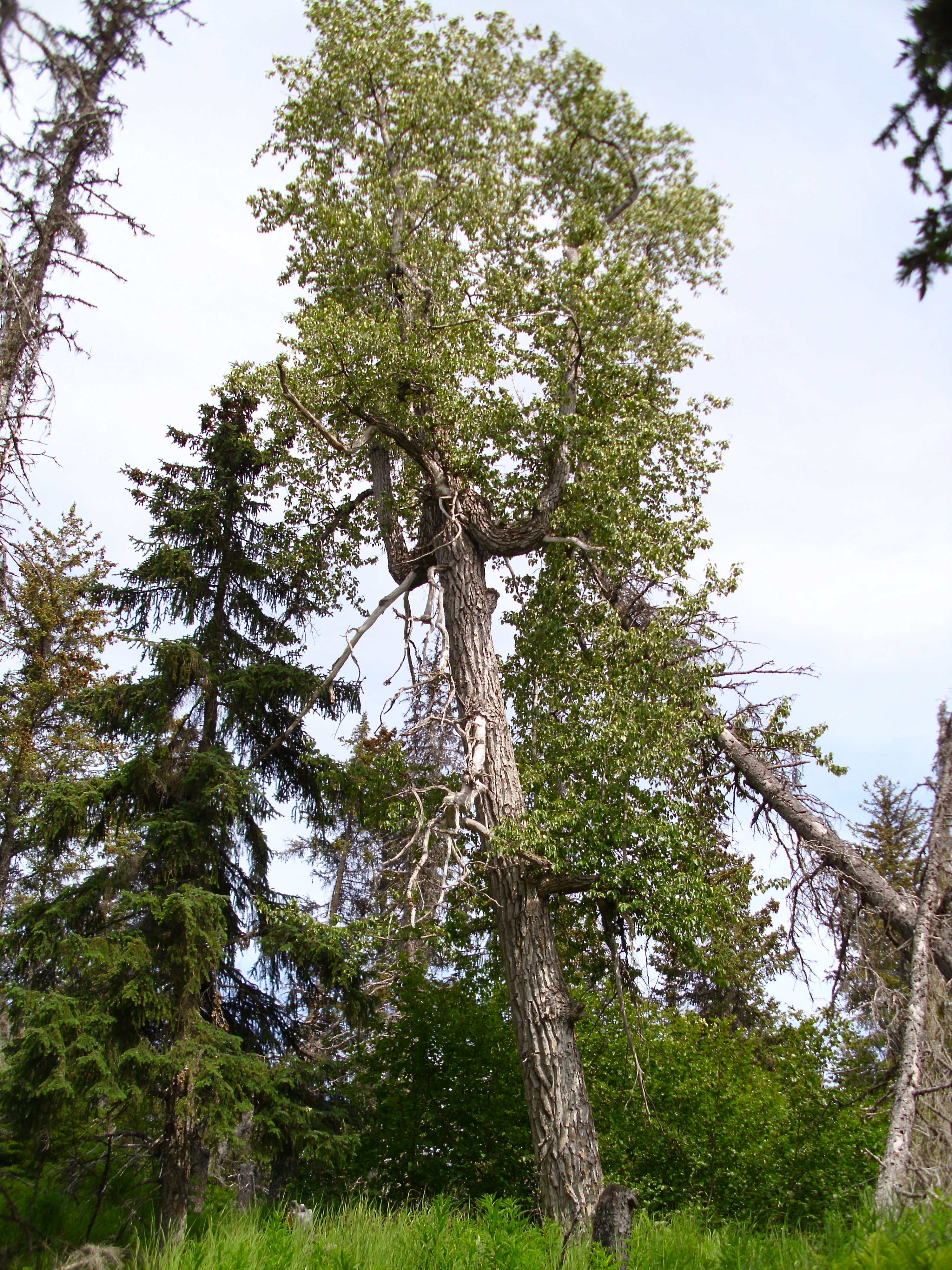
Tall growth habit
Black cottonwood can grow into a tall tree with a long trunk. Use the whole-tree view for context, then check a reachable twig or recently fallen leaf.
Black Cottonwood vs. Eastern Cottonwood
Look at several mature leaves. Leaf shape varies, so use the stalk and teeth together.
| Feature | Black cottonwood | Eastern cottonwood |
|---|---|---|
| Scientific name | Populus trichocarpa | Populus deltoides |
| Leaf shape | Usually broadly oval with a pointed tip and rounded base | Often triangular with a broad, nearly straight or shallowly heart-shaped base |
| Leaf teeth | Fine | Coarser, often rounded |
| Leaf stalk | Round in cross section | Flattened from side to side |
| Seed fluff | Female trees release cottony seeds | Female trees also release cottony seeds |
Other Black Cottonwood Look-Alikes
- Quaking aspen ( Populus tremuloides ) typically has smaller, rounder leaves and flattened stalks that let the leaves flutter in a light breeze.
- Red alder ( Alnus rubra ) often grows along the same streams. Look for coarser leaf teeth, margins that roll under, and small woody seed cones that can remain in winter.
- Planted poplars and hybrids can share features with black cottonwood. Compare mature leaves, stalks and buds before making a firm identification.
Black Cottonwood in Western Washington
Look for black cottonwood along rivers and streams, on floodplains, and on open, moist ground. Seedlings can establish on exposed sand or silt left by receding water.
Black cottonwood can grow tall quickly where it has sun and moisture. To document a tree, photograph the whole crown and trunk, both sides of a leaf, and a twig tip. A photo of a fruiting branch can show where the spring fluff is coming from.
Black Cottonwood Identification FAQs
What is the fastest way to identify black cottonwood?
Look for a broad, finely toothed leaf with a pale underside and a round leaf stalk. Check the same tree for long, pointed, resinous buds.
Can I identify black cottonwood in winter?
Look at the ends of the twigs for long, pointed, orange-brown buds. Deeply furrowed bark on a mature trunk is a supporting clue. Check the leaf and its stalk once foliage returns if other poplars are nearby.
Do all black cottonwoods produce white fluff?
Female trees release cottony seeds from capsules. Male trees produce pollen catkins. The white hairs help the seeds travel in the wind.
Is cottonwood fluff pollen?
The visible fluff is made of silky hairs attached to seeds. Pollen comes from male catkins earlier in the season.
How can I tell black cottonwood from eastern cottonwood?
Check the leaf stalk and edge together. Black cottonwood has a round stalk and fine teeth. Eastern cottonwood has a flattened stalk and generally coarser teeth.
Where does black cottonwood grow in Western Washington?
Look along rivers, streams and floodplains, especially on open sites where fresh sediment and moisture allow seedlings to establish.
References and Photo Credits
Photographer credits and licenses appear beside each image. For another native tree you may see along Western Washington streams, see our red alder identification guide.