Hedge Trimming Cost in Seattle (2026 Pricing Guide)

Written By: Eric Ledford
ISA Certified Arborist – PN-9290A
ISA Qualified Tree Risk Assessor (TRAQ)
Hedge trimming costs in Seattle typically range from under $100 for small maintenance pruning to several thousand dollars for large privacy hedge reduction projects. Pricing depends on hedge height, species, access, debris volume, terrain, and whether the work involves routine trimming or structural reduction pruning.
Written by ISA Certified Arborist Eric Ledford
Average Hedge Trimming Costs in Seattle
Hedge trimming costs in Seattle can range from under $100 for small ornamental shrubs to several thousand dollars for large privacy hedge reduction projects. Most residential hedge trimming services typically fall between $150 and $1,200 depending on the hedge size, species, access conditions, and the level of pruning required.
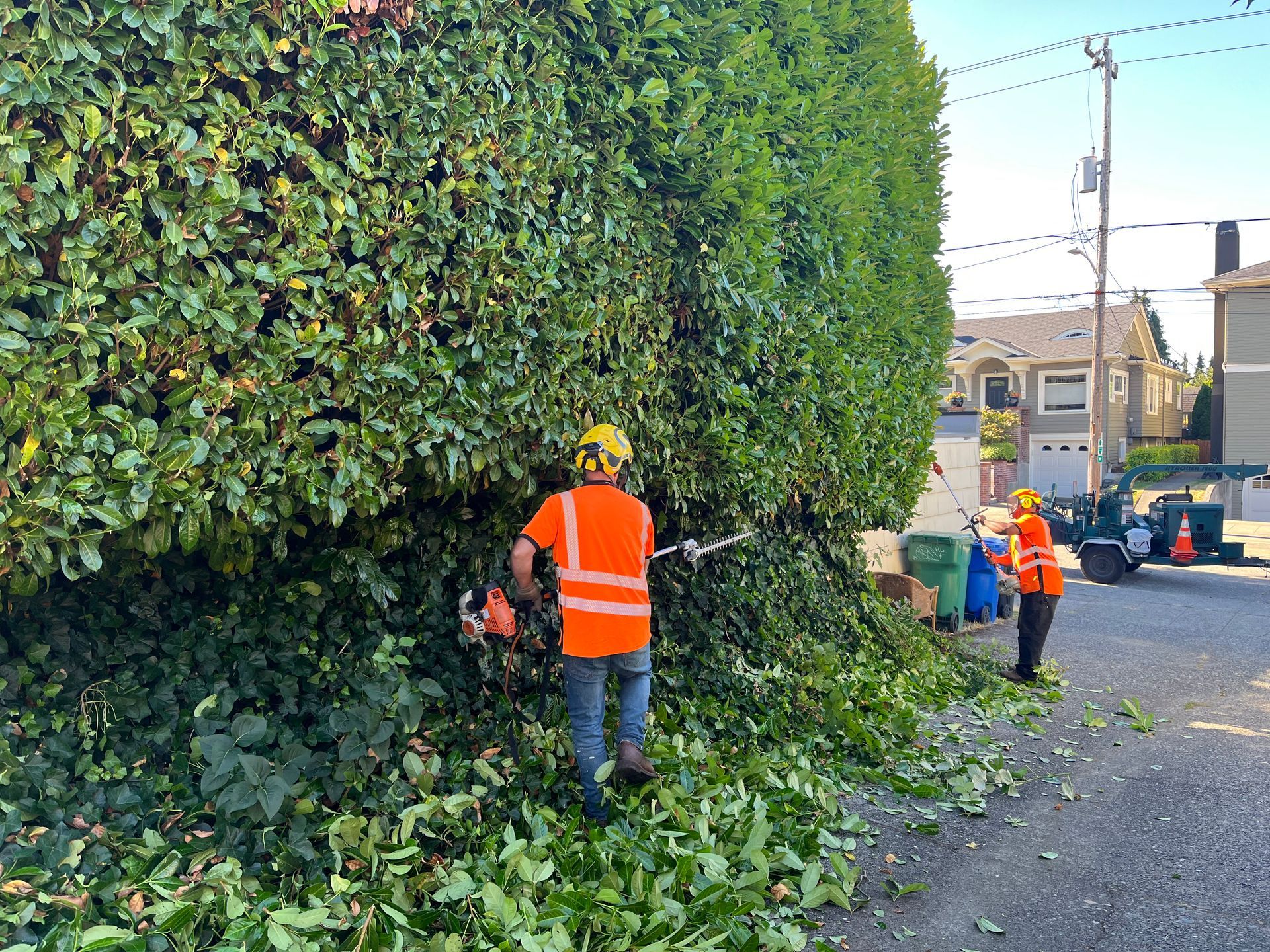
In the Puget Sound region, hedge trimming pricing is heavily influenced by factors like fast-growing evergreen species, steep terrain, limited access, debris volume, and whether the work involves routine maintenance or structural reduction pruning. A small boxwood hedge along a front walkway may only require light shaping, while a 20-foot-tall English laurel privacy screen may require chainsaw-based structural pruning, climbing, or extensive debris haul-off.
Typical Hedge Trimming Price Ranges in Seattle
- Small hedge trimming: $85–$250
Low ornamental hedges, foundation shrubs, or light maintenance pruning. - Medium hedge trimming: $250–$750
Common residential privacy hedges and seasonal maintenance trimming. - Large hedge trimming: $750–$2,500+
Tall privacy hedges, extensive reductions, difficult access, or large debris volumes. - Structural hedge reduction: $500–$3,000+
Overgrown hedges requiring arborist-style pruning, interior structure restoration, or staged reductions. - Hedge removal: Starts around $250 and increases based on size, root systems, access, and haul-off requirements.
Seattle hedge trimming costs also vary based on hedge species. Fast-growing plants like English laurel, Leyland Cypress, and arborvitae often require more frequent maintenance than slower-growing ornamental hedges. Some species tolerate aggressive pruning well, while others can suffer permanent damage from improper timing or over-trimming.
For most homeowners, the best way to get an accurate hedge trimming price is with an on-site estimate. Factors like slope, gate access, overhead utilities, cleanup preferences, and desired appearance can significantly affect the final cost.
| Service | Price Range |
|---|---|
| Small Hedge Trimming | $85-$170 |
| Medium Hedge Trimming | $150 - $300 |
| Large Hedge Trimming | $300+ |
| Overgrown Hedge Reduction (Structural Restructuring) | $500+ |
| Hedge Removal | Starts at $250 |
How Much Does Hedge Trimming Cost in Seattle?
- Small hedge: $300–$600
- Medium: $600–$1,200
- Large/privacy hedge: $1,500+
Hedge trimming costs in Seattle can vary significantly depending on hedge height, length, access, and overall condition. Small, regularly maintained hedges are typically quick to service, while tall privacy hedges or overgrown hedges often require more time, specialized equipment, and structural pruning techniques. Properties with slopes, tight access, or large volumes of debris may also increase the total cost.
The best way to get an accurate price is with an on-site estimate. Our ISA Certified Arborists evaluate your hedge type, condition, and access to provide a clear, fixed quote — not a rough guess.
What Affects Hedge Trimming Cost?
Hedge trimming costs in Seattle can vary dramatically depending on the size of the hedge, the species being maintained, access conditions, debris volume, and whether the work involves routine maintenance or structural pruning. Two hedges may appear similar from the street but require completely different levels of labor, equipment, and cleanup once inspected onsite.
Most professional hedge trimming estimates are based on a combination of:
- Hedge height and overall length
- Species and growth rate
- Access and terrain conditions
- Debris volume and haul-off needs
- Frequency of maintenance
- Whether the hedge requires routine trimming or corrective reduction pruning
🌿 Hedge Height & Size
Tall privacy hedges require significantly more labor than low ornamental hedges. Large English laurel, arborvitae, and Leyland Cypress hedges may require ladders, climbing equipment, pole trimmers, or multiple crew members to prune safely and consistently. Long hedge lines also increase trimming time, cleanup volume, and disposal costs.
🌲 Hedge Species
Different hedge species require different pruning approaches. Fast-growing species like English laurel and Leyland Cypress typically require more frequent trimming than slower-growing ornamental hedges. Some species tolerate aggressive pruning well, while others can suffer permanent thinning, dieback, or sun exposure damage if improperly cut.
🪜 Access & Terrain
Seattle-area properties often include steep slopes, retaining walls, narrow side yards, limited gate access, or waterfront terrain that can significantly increase labor time. Limited access may require debris to be moved by hand rather than directly chipped into a truck, increasing production time and cleanup costs.
🪵 Debris Cleanup & Haul-Off
Hedge debris can become surprisingly heavy and time-consuming to process, especially wet evergreen material like laurel or cedar. Some homeowners keep chipped material onsite as mulch, while others request full debris haul-off and site cleanup. Disposal requirements can significantly affect total pricing.
✂️ Routine Trimming vs Structural Reduction
Routine hedge maintenance is usually much less expensive than overgrown hedge restoration. Severely overgrown hedges often require structural reduction pruning using chainsaws and arborist-style pruning techniques rather than standard hedge trimmers. Large reductions may also need to be completed in stages to avoid excessive plant stress.
📅 Frequency of Maintenance
Hedges that receive regular maintenance are typically faster and less expensive to trim than neglected hedges that have been allowed to overgrow for several years. Annual or semi-annual maintenance pruning usually helps reduce long-term costs while improving hedge density, appearance, and structural health.
💡 Why Hedge Estimates Can Vary So Much
Two hedges may look similar from the street but require completely different levels of labor once inspected onsite. Hidden slope conditions, difficult access, debris handling, previous pruning quality, hedge species, and overall plant health can dramatically change the time and equipment required for the work. That’s why most professional hedge trimming companies provide onsite estimates instead of relying on flat online pricing calculators.
Get a Hedge Trimming Estimate in Seattle 🌿
Hedge trimming costs can vary significantly depending on hedge height, species, access conditions, debris volume, and whether the work involves routine maintenance or structural reduction pruning. The most accurate way to price hedge trimming is with an onsite estimate from an ISA Certified Arborist.
At Sound Tree Care, we evaluate your hedge type, growth habits, access limitations, and long-term maintenance goals to recommend the right pruning approach for your property.
- ✔ English laurel, arborvitae, boxwood, privet, yew, and cedar hedges
- ✔ Routine maintenance trimming and overgrown hedge reduction
- ✔ HOA, residential, estate, and commercial hedge maintenance
- ✔ Cleanup, debris haul-off, and optional onsite mulch retention
- ✔ ISA Certified Arborists and ANSI A300 pruning standards
Hedge Trimming Cost by Hedge Type
Different hedge species grow at different rates, tolerate pruning differently, and produce different amounts of debris. In the Seattle area, fast-growing evergreen privacy hedges usually cost more to maintain than small ornamental hedges because they require more frequent trimming, more cleanup, and more careful pruning decisions.
🌿 English Laurel Hedge Trimming
English laurel is one of the most common privacy hedge species in Seattle and the Puget Sound region. It grows aggressively, produces dense debris, and can quickly become expensive if routine maintenance is delayed.
- Maintenance frequency: often 1–2 times per year
- Cost increases with height, depth, and debris volume
- Large reductions may require chainsaws and structural pruning
🌲 Arborvitae Hedge Trimming
Arborvitae hedges are common privacy screens, but they require careful pruning because they do not recover well from aggressive cuts into old interior wood. Pricing depends heavily on height, access, and whether the hedge has been maintained regularly.
- Maintenance frequency: usually once per year
- Deep cuts can permanently thin the hedge
- Best maintained with light, consistent trimming
🌳 Leyland Cypress Hedge Maintenance
Leyland Cypress grows quickly in the Pacific Northwest and can form excellent privacy screens when maintained regularly. If neglected, these hedges can become tall, wide, and difficult to reduce without affecting structure or appearance.
- Maintenance frequency: usually 1–2 times per year
- Costs increase sharply when height control is delayed
- Often requires ladder work or pole pruning for tall screens
✂️ Boxwood Hedge Trimming
Boxwood hedges are usually smaller, but they require more precision than many privacy hedges. Formal shaping, clean lines, and repeated light trimming can increase labor even when the hedge itself is not especially large.
- Maintenance frequency: 2–4 light trims per year for formal shapes
- Best pruned carefully to avoid thinning and poor regrowth
- Common for entryways, borders, and ornamental landscapes
🌱 Privet Hedge Trimming
Privet is commonly used for formal and semi-formal hedges. It usually responds well to routine trimming, but neglected privet hedges can become woody and require more corrective pruning to restore shape and density.
- Maintenance frequency: 1–3 times per year
- Formal hedges require more frequent light shaping
- Overgrown hedges may require staged restoration
🌲 Yew & Cedar Hedge Trimming
Yew and cedar hedges can make attractive long-term screens, but they require species-aware pruning. Some tolerate selective reduction better than others, while cedar hedges can be permanently damaged by overly aggressive cuts.
- Maintenance frequency: usually once per year
- Costs vary based on species, height, and pruning tolerance
- Best handled with conservative, arborist-guided pruning
💡 Why Hedge Species Matter
Two hedges with the same height and length can have very different trimming costs. Growth rate, pruning tolerance, debris density, access, and long-term maintenance history all affect the amount of labor required. That is why species identification is an important part of a professional hedge trimming estimate.
Overgrown Hedge Trimming Costs
Overgrown hedge trimming usually costs more than routine hedge maintenance because the work often shifts from simple shearing to structural reduction pruning. Once a hedge becomes too tall, too wide, or too woody, crews may need chainsaws, pole saws, ladders, climbing equipment, and significantly more cleanup time.
In Seattle, overgrown English laurel, arborvitae, Leyland Cypress, and cedar privacy hedges are common examples. These hedges may have years of accumulated growth, heavy interior wood, limited access, and large volumes of debris that need to be chipped or hauled away.
🌿 Routine Maintenance
Light seasonal trimming to maintain shape, height, and clean edges. This is usually the least expensive option when hedges are maintained regularly.
✂️ Corrective Reduction
Moderate reductions to regain clearance, improve structure, and restore a manageable hedge size after one or more missed maintenance cycles.
🪚 Structural Restoration
Heavy reduction work for large, woody, neglected hedges. This may require arborist-style pruning, staged reductions, or selective removal.
Typical Overgrown Hedge Cost Ranges
- Light overgrowth:$300–$900 for routine reshaping and cleanup
- Moderate overgrowth:$900–$2,500 for height reduction, access clearing, and heavier debris handling
- Severe overgrowth:$2,500–$5,000+ for large privacy hedge reduction, chainsaw work, climbing, or extensive haul-off
Large overgrown hedges can also require a different pruning strategy than routine trimming. Cutting too aggressively into the wrong species can expose bare interior wood, create permanent thinning, or trigger decline. Arborvitae and cedar hedges are especially sensitive to deep cuts, while English laurel can often tolerate heavier reduction when timed and executed correctly.
⚠️ Overgrown Hedges Are Not Always a One-Day Fix
Some neglected hedges should be reduced in stages rather than cut back aggressively all at once. A staged approach can protect plant health, preserve screening, and reduce the risk of creating a bare or permanently damaged hedge.
Hedge Removal vs Hedge Trimming Cost
Homeowners often compare hedge trimming costs against full hedge removal — especially when a hedge has become severely overgrown, difficult to maintain, or no longer fits the property. In many cases, regular hedge maintenance is significantly less expensive than removing and replacing a mature hedge system.
However, some neglected or poorly placed hedges eventually become more expensive to repeatedly reduce than to remove entirely. Large English laurel, Leyland Cypress, arborvitae, bamboo, and cedar privacy screens are common examples throughout Seattle and the Puget Sound region.
✂️ Hedge Trimming
- Usually the lower-cost option for maintained hedges
- Preserves privacy screening and curb appeal
- Can improve long-term plant health and structure
- Typically ranges from seasonal maintenance to structural reduction
- May require ongoing yearly maintenance costs
- Ideal for healthy hedges with manageable size and access
🪚 Hedge Removal
- Often higher upfront cost than trimming
- May include cutting, stump grinding, haul-off, and root removal
- Useful when hedges are dead, invasive, or severely overgrown
- Can improve usable yard space, sunlight, or access
- Large root systems may impact fences, sidewalks, or drainage
- Replacement planting may add additional costs
💰 Typical Hedge Removal Cost Ranges
Small hedge removals may start around $250–$600, while large privacy hedge systems can range from $1,500 to $5,000+ depending on hedge height, root size, access, slope, debris volume, and whether stump grinding or root chasing is required.
For many Seattle homeowners, the most cost-effective strategy is consistent hedge maintenance before major reductions become necessary. Routine trimming helps prevent excessive height, woody interior growth, and large future restoration costs.
🌿 Sometimes Partial Removal Makes More Sense
In some cases, homeowners choose to remove only part of a hedge system to improve light, reduce maintenance costs, or regain usable space while preserving privacy screening elsewhere on the property.
🧮 Looking for a Hedge Trimming Cost Calculator?
If you searched for a hedge trimming cost calculator, you’re not alone. The challenge is that no online calculator can accurately account for real-world site conditions.
- Actual and target hedge height
- Terrain and access limitations
- Equipment needed and crew time
- Debris volume for disposal or chipping
A hedge that’s 4 feet tall on flat ground may be simple. But at 12 feet high on a slope behind a fence, the complexity — and cost — changes fast.
That’s why we offer something better:
📩
Request a free quote from our ISA Certified Arborists — it’s fast, easy, and based on your property, not an algorithm.
Why Online Hedge Trimming Cost Calculators Are Often Wrong
Online hedge trimming calculators can provide rough starting points, but they often fail to account for the real-world conditions that dramatically affect hedge trimming costs in Seattle and the Puget Sound region.
Two hedges with the same height and length may require completely different levels of labor, equipment, cleanup, and pruning strategy once inspected onsite. That is why most professional hedge trimming companies rely on in-person estimates rather than simple square footage or linear footage calculators.
🪜 Access Conditions
Narrow gates, retaining walls, steep slopes, limited parking, waterfront properties, and backyard-only access can significantly increase labor time and debris handling.
🌿 Hedge Species
English laurel, arborvitae, Leyland Cypress, cedar, and boxwood all grow differently and require different pruning methods, equipment, and maintenance schedules.
🪵 Debris Volume
Wet evergreen hedge debris becomes extremely heavy and time-consuming to chip, move, and haul away — especially during major reductions.
✂️ Pruning Complexity
Routine maintenance trimming is very different from structural hedge restoration, corrective pruning, or staged reductions on overgrown privacy hedges.
💡 Real Hedge Estimates Require Real Inspection
Professional hedge trimming estimates are based on hedge condition, pruning tolerance, site access, cleanup logistics, and long-term maintenance goals — not just hedge height or linear footage alone.
How Homeowners Can Reduce Long-Term Hedge Maintenance Costs
One of the best ways to reduce hedge trimming costs over time is to avoid letting hedges become severely overgrown. Regular maintenance trimming is almost always less expensive than major corrective reductions, structural restoration, or full hedge removal.
In Seattle and the Puget Sound region, fast-growing evergreen hedges like English laurel, arborvitae, and Leyland Cypress can quickly become oversized if they are neglected for multiple seasons.
✂️ Schedule Routine Maintenance
Smaller, more frequent hedge trimming visits usually cost less than waiting several years between reductions.
🌿 Choose the Right Hedge Species
Some hedges grow dramatically faster than others. Selecting slower-growing species can reduce yearly maintenance needs.
🪵 Avoid Severe Overgrowth
Large woody stems require chainsaws, heavier cleanup, and more labor than light seasonal trimming with hedge trimmers.
🚛 Keep Access Areas Clear
Easy access for crews and equipment can significantly reduce labor time and debris hauling costs.
💡 Healthy Hedges Usually Cost Less to Maintain
Proper watering, spacing, pruning timing, and plant health care can help hedges maintain denser growth, stronger structure, and better long-term appearance — reducing future restoration costs.
DIY vs. Professional Hedge Trimming
Small ornamental hedges can sometimes be maintained by homeowners using basic hedge trimmers and hand tools. However, large privacy hedges, overgrown evergreen screens, and tall hedge reductions often require significantly more experience, equipment, and pruning knowledge than many homeowners expect.
In Seattle and the Puget Sound region, fast-growing hedge species combined with steep terrain, wet debris, and limited access conditions can make hedge trimming far more labor-intensive than it initially appears.
🪜 DIY Hedge Trimming
- Can work well for small ornamental hedges and light touch-up pruning
- Lower upfront cost if tools are already owned
- May become difficult for tall, wide, or dense evergreen hedges
- Ladder use and uneven terrain increase injury risk
- Improper cuts can permanently thin arborvitae and cedar hedges
- Cleanup and debris hauling are often underestimated
🌿 Professional Hedge Trimming
- Better for large privacy hedges and structural reduction work
- Professional crews can trim more evenly and efficiently
- ISA Certified Arborists understand species-specific pruning tolerance
- Includes cleanup, debris hauling, and professional equipment
- Can help preserve hedge density, structure, and long-term appearance
- Reduces risk of overcutting or permanently damaging the hedge
💡 Improper Hedge Trimming Can Create Long-Term Problems
Aggressive reductions, improper timing, or cutting too deeply into certain hedge species can create bare interior sections, weak regrowth, permanent thinning, or long-term structural issues. Professional pruning is often less expensive than correcting severe hedge damage later.
Get a Hedge Trimming Estimate in Seattle
Every hedge property is different. Factors like hedge species, access, height, debris volume, and pruning goals can dramatically affect the cost of hedge trimming and long-term maintenance.
Sound Tree Care provides professional hedge trimming, structural hedge reduction, and privacy hedge maintenance throughout Seattle and the greater Puget Sound region.
✔ ISA Certified Arborists ✔ Residential & HOA hedge maintenance ✔ Cleanup & debris haul-off included