
Young Tree Training Guide: Structural Pruning for Strong, Healthy Trees

February 6, 2023
Smiling person in a red bike helmet, taking a selfie outdoors under trees.

Written By: Eric Ledford

ISA Certified Arborist – PN-9290A 

ISA Qualified Tree Risk Assessor (TRAQ)

pruning young trees for structure and from in seattle wa, sound tree care

Guide To Structural Pruning Of Young Trees

Did you recently plant a young tree or shrub? How you care for it during the first several years can strongly influence its structure, health, and ability to thrive.

Watering, mulching, and support systems are important during establishment, but structural pruning is also essential. Young tree pruning should be performed carefully because each pruning cut can permanently influence the tree’s growth pattern, branch structure, and long-term form.

Pruning young trees for structure and form helps reduce future limb failures, codominant stems, included bark, and poor branch attachments. In most cases, major structural pruning should wait until the tree has had time to establish after planting, while light corrective pruning may be appropriate earlier when defects are obvious.

Below are practical tips for pruning young trees for structure, form, clearance, and long-term strength.

Establish Young Tree Pruning Objectives

Before making pruning cuts, establish a clear objective for the work. Structural pruning should be intentional and focused on guiding future growth rather than simply removing branches. The objectives below represent the most common reasons ISA Certified Arborists perform structural pruning on young trees.

🌿 Remove Defects

Remove dead, dying, broken, or diseased branches before they become larger problems.

🌳 Build Structure

Develop a strong central leader and healthy branch architecture.

🚗 Create Clearance

Prevent conflicts with pedestrians, vehicles, buildings, and infrastructure.

💪 Reduce Breakage

Thin heavy branches and future sail branches before they become hazards.

🌱 Improve Long-Term Tree Health

Good young tree training helps develop balanced canopy growth, stronger branch attachments, better light distribution, and a more stable mature form. Small corrective cuts made early can reduce the need for larger pruning cuts, cabling, bracing, or risk mitigation later in the tree’s life.

🌳 Need Help Evaluating a Young Tree?
Structural pruning decisions made during a tree's first 10–15 years influence its health, safety, and branch architecture for decades. An ISA Certified Arborist can identify codominant stems, included bark, poor branch spacing, and developing structural defects while they are still inexpensive to correct. Small pruning decisions made today often prevent future branch failures, storm damage, and costly corrective pruning as the tree matures.
Schedule An Arborist Consultation →

Once you've established your pruning objectives, it's important to understand what structural pruning actually involves—and why it differs from routine maintenance pruning.

What Is Structural Pruning?

Pruning young trees for structure graphic

Structural pruning is the practice of selectively removing or reducing branches in a young tree to develop strong branch attachments, a dominant central leader, balanced canopy growth, and long-term structural stability. Unlike routine pruning that focuses primarily on clearance or appearance, structural pruning is performed to guide future growth and prevent common defects such as codominant stems, included bark, weak branch unions, and overextended limbs.


When performed during a tree's early years, structural pruning can improve storm resistance, reduce future maintenance costs, and help trees develop a stronger framework capable of supporting decades of healthy growth.
🌳 Structural Pruning Goals

Structural pruning guides the development of young trees by encouraging strong branch attachments, a dominant central leader, and balanced canopy growth.

Unlike routine pruning focused on clearance or appearance, structural pruning helps prevent defects that may lead to branch failure, trunk splitting, or expensive corrective work later in the tree's life.

✅ Benefits Of Structural Pruning

  • Establishes a strong central leader
  • Reduces codominant stem development
  • Improves branch attachment strength
  • Reduces future branch and trunk failures
  • Lowers long-term maintenance costs
  • Improves storm resistance and tree longevity

⚠️ Why Structural Pruning Prevents Future Tree Problems

Many hazardous trees evaluated by ISA Certified Arborists throughout Seattle and the Puget Sound region developed structural defects while young. Early structural pruning can correct codominant stems, included bark, overextended branches, and poor branch attachments before they become significant tree risk concerns.

What Are Codominant Stems?

Codominant stems occur when a tree develops two or more competing leaders of similar size growing from the same point on the trunk. Instead of forming a single dominant trunk, the tree divides its growth between multiple stems that compete for dominance as the tree matures.

While codominant stems may appear normal when a tree is young, they often become one of the most significant structural defects found during professional tree inspections and tree risk assessments. As the stems increase in diameter, the attachment point between them is frequently weak and prone to failure under wind, snow loads, or the increasing weight of the canopy.

🌳 Signs of Codominant Stems

  • Two trunks of similar diameter growing from the same point
  • Multiple leaders competing near the top of the tree
  • Narrow branch attachment angles
  • Bark becoming trapped between stems
  • Visible seams or cracks forming at the union
  • Fast-growing upright stems competing for dominance

⚠️ Why Codominant Stems Matter

  • Increase the likelihood of stem and trunk failure
  • Frequently lead to included bark defects
  • Create weak attachment points within the canopy
  • Become more difficult and expensive to correct as trees mature
  • Commonly contribute to storm damage and property loss
  • May require ongoing pruning, monitoring, or risk mitigation

📋 Codominant Stems Are Easier to Correct When Trees Are Young

Structural pruning is most effective when codominant stems are identified and corrected early. By selectively reducing or removing competing leaders, an arborist can encourage the development of a stronger central leader and improve the tree’s long-term structural stability. Once codominant stems become large, correction becomes more difficult and may require ongoing maintenance, cabling, bracing, or formal tree risk assessment.

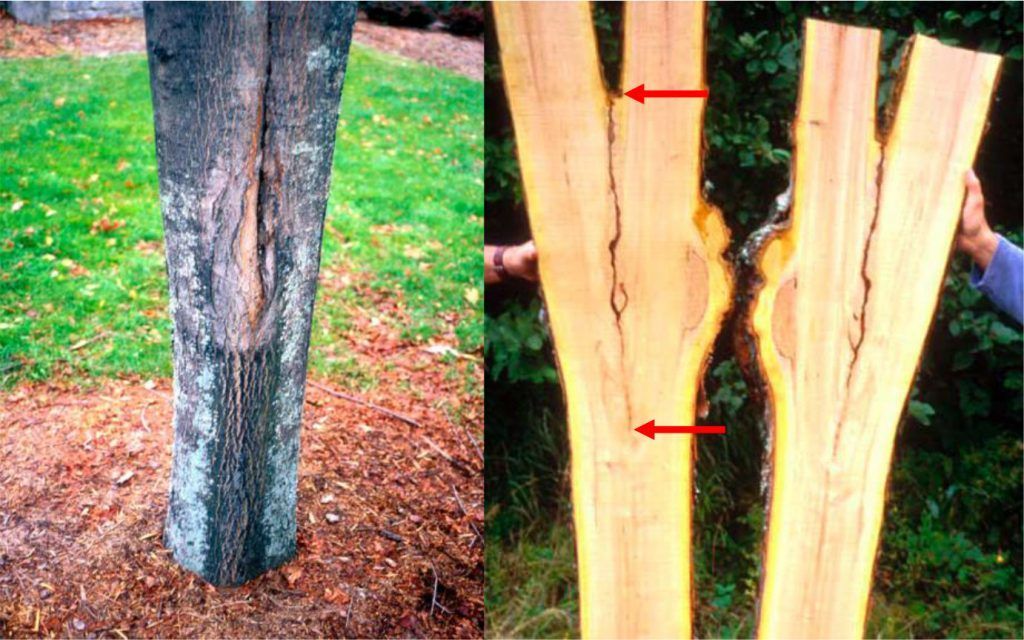
What Is Included Bark?

Picture of included bark

Included bark occurs when bark becomes trapped between two stems or branches as they grow together. Instead of forming a strong wood-to-wood connection, the tree develops a weak attachment point that is frequently associated with codominant stems.


As the stems increase in diameter, the bark becomes more deeply embedded and prevents the attachment from developing normal structural strength. Wind, snow, and seasonal movement can place significant stress on the weakened union.


Structural pruning is often the most effective way to prevent included bark defects. By identifying and managing competing leaders while the tree is young, arborists can encourage stronger branch attachments and reduce the likelihood of future failures.

🔍 Signs of Included Bark

  • Narrow branch attachment angles
  • Two stems pressing tightly together
  • Bark visible between competing leaders
  • A seam or crack developing along the union
  • Swelling around the attachment point
  • Codominant stems of similar diameter

Included bark is often easiest to identify while trees are young. Early detection allows corrective pruning before the defect becomes a significant structural concern.

⚠️ Why Included Bark Matters

  • Creates weak branch and stem attachments
  • Increases the likelihood of branch failure
  • Can lead to trunk splitting in mature trees
  • Frequently contributes to storm damage
  • Often requires ongoing monitoring or mitigation
  • Becomes harder to correct as the tree matures

Many hazardous trees evaluated during professional tree risk assessments contain included bark defects that began developing decades earlier.

🌳 Why Early Structural Pruning Works

Structural pruning helps prevent included bark by reducing competing leaders while branches are still small. Corrective pruning performed during a tree's first decade can significantly improve branch attachment strength and reduce the likelihood of future failures, storm damage, and expensive mitigation work later in life.

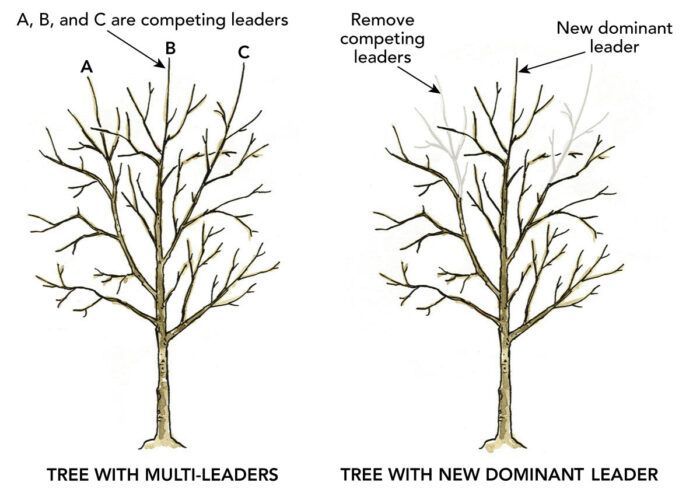
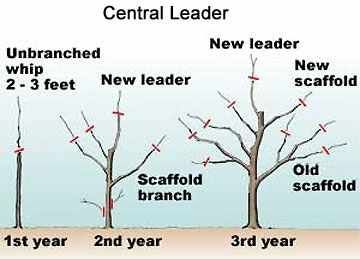
What Is Central Leader Pruning?

Central Leader Pruning Method Graphic

Central leader pruning is a structural pruning technique used to encourage a tree to develop a single dominant trunk. By managing competing stems early, arborists can improve branch attachment strength, canopy structure, and long-term stability.


Many shade trees commonly planted throughout Seattle—including maples, oaks, elms, lindens, and numerous street tree species—naturally benefit from maintaining one dominant leader. Without intervention, competing leaders may develop codominant stems and included bark defects.


Early structural pruning is often the simplest and most cost-effective way to guide branch architecture while pruning cuts are still small. Corrective pruning performed during a tree's first decade can significantly reduce future maintenance requirements and storm-related failures.

🌲 What Is A Central Leader?

A central leader is the primary vertical stem that forms the main trunk of a tree. In many species, maintaining one dominant leader creates stronger branch attachments, better structure, and improved long-term stability.

When multiple stems compete for dominance, codominant stems and included bark defects often develop, increasing the likelihood of future failures.

✅ Benefits Of Central Leader Pruning

  • Creates a stronger trunk structure
  • Reduces codominant stem development
  • Improves branch attachment strength
  • Reduces storm damage potential
  • Encourages balanced canopy growth
  • Improves long-term tree health and stability

⚠️ Why Early Intervention Matters

Central leader pruning is most effective during a tree's first 5–15 years of growth. Small corrective cuts can guide branch structure with minimal stress to the tree. Waiting until codominant stems become large often requires more aggressive pruning, cabling, bracing, ongoing maintenance, or formal tree risk assessments.

Structural Pruning Checklist

Use this structural pruning checklist to identify common pruning objectives, prevent future defects, and guide young trees toward a stronger, safer, and more attractive mature form.

🌳 Central Leader

Establish and maintain one dominant leader whenever possible.

🌿 Crown Development

Identify the lowest permanent branch and gradually remove branches below it.

📏 Branch Spacing

Space scaffold branches evenly along the trunk to improve strength and balance.

💪 Reduce Sail Branches

Keep branches proportionate to trunk diameter and shorten heavy limbs when necessary.

⚠️ Prevent Included Bark

Suppress competing stems before codominant leaders and included bark develop.

✂️ Proper Pruning Cuts

Always prune outside the branch collar and never make flush cuts.

📘 Learn More About Young Tree Pruning

Download a visual guide to structural pruning and learn more about fruit tree pruning techniques for developing strong branch architecture and healthy growth.

Not sure what to prune?
Young tree pruning decisions can affect structure for decades. Our arborists can identify codominant stems, included bark, and branch spacing issues before they become expensive problems.

Request Young Tree Pruning Help

When To Prune Young Trees

Young tree pruning is best performed during the dormant season when branch structure is visible and pruning cuts can be planned more effectively. However, the ideal timing depends on the species, the pruning objective, and the type of defect being corrected.

Structural pruning focuses on developing a strong central leader, improving branch spacing, reducing codominant stems, and correcting defects while branches are still small. Most structural pruning cuts should be made before defects become large enough to require significant branch removal. The following recommendations apply to most young trees growing in the Pacific Northwest, including the Seattle area.

❄️ Winter

Best for structural pruning

Dormant-season pruning makes branch structure easier to see and is usually the preferred time for major young tree training.

☀️ Summer

Good for light corrections

Useful for removing water sprouts, suckers, overly vigorous shoots, and making minor structure or clearance corrections.

🌱 Spring

Use caution

Some trees tolerate spring pruning, but timing depends on species, sap flow, flowering, and the pruning objective.

🍂 Fall

Usually avoid

Fall is generally not ideal for major structural pruning unless the work is urgent or species-specific timing calls for it.

💡 Arborist Tip

Many hazardous trees identified during professional tree risk assessments developed structural defects when they were young. Correcting codominant stems, poor branch attachments, and included bark early is one of the most cost-effective investments you can make in a tree's long-term health and safety.

How Much Of A Young Tree Should Be Pruned?

Structural pruning is intended to make small corrective cuts while branches are still young and manageable. In most cases, only a small portion of the canopy is removed during a structural pruning cycle.

The goal is not to remove large amounts of foliage. Instead, structural pruning focuses on:

  • Developing a dominant central leader
  • Reducing codominant stems
  • Correcting poor branch attachments
  • Improving branch spacing
  • Managing competing scaffold branches
  • Removing dead, damaged, or defective growth

Most young trees benefit from periodic corrective pruning every few years rather than large pruning events.

💡 Arborist Tip

The best structural pruning cuts are often the smallest ones. Correcting a defect when a branch is 1 inch in diameter is significantly easier than waiting until it becomes a 10-inch limb.

Pruning Young Street Trees In Seattle

City of Seattle Graphic

Trees growing within Seattle's public right-of-way often have different management requirements than trees located entirely on private property.


Young street trees are commonly pruned to:


  • Maintain pedestrian clearance
  • Improve visibility near intersections
  • Reduce conflicts with signs and utilities
  • Develop strong branch structure
  • Improve long-term public safety
  • Property owners are typically responsible for routine care of many street trees adjacent to their property, although specific responsibilities depend on ownership and location.

Because Seattle's street tree regulations and permitting requirements change periodically, property owners should verify current requirements with SDOT before performing significant pruning, removals, planting, or other alterations to trees located within the public right-of-way.

🌳 Why Structural Pruning Matters For Street Trees

Many of Seattle's most expensive street tree problems begin when young trees are not properly trained. Early structural pruning can reduce future sidewalk conflicts, improve clearance over streets and sidewalks, and decrease the likelihood of branch failures as the tree matures.

Why Hire An Arborist For Structural Pruning?

ISA Certified Arborist Badge

Structural pruning may appear simple, but the decisions made during a tree's early years can affect its health, stability, appearance, and maintenance requirements for decades.


A qualified arborist understands how trees develop over time and can identify structural defects before they become serious problems. Issues such as codominant stems, included bark, poor branch spacing, competing leaders, and overextended limbs are often much easier to correct when a tree is young.


Unlike routine pruning, structural pruning requires evaluating the future architecture of the tree rather than simply removing branches that are currently in the way.

Common Structural Defects Corrected During Young Tree Pruning

✅ Codominant stems✅ Included bark defects✅ Competing central leaders✅ Poor branch spacing

✅ Weak branch attachments✅ Developing sail branches✅ Clearance conflicts with buildings and infrastructure

🌲 Codominant Stems

Correct competing leaders before they develop weak unions and structural defects.

⚠️ Included Bark

Identify bark trapped between stems before it leads to future branch or trunk failure.

🌳 Central Leaders

Establish a dominant central leader to improve long-term tree structure and stability.

📏 Branch Spacing

Improve scaffold branch distribution and reduce future conflicts within the canopy.

💪 Branch Attachments

Encourage stronger branch unions that better withstand wind, snow, and storm loading.

🏡 Clearance Management

Prevent future conflicts with homes, sidewalks, streets, vehicles, and infrastructure.